

The Alma Philosophy: Cacao, Balance and Modern Life

Modern Life Has Pulled Us Out of Balance
Modern life is fast, connected (at least digitally),and constantly demanding our attention.
It can feel relentless and exhausting. From the moment we wake up, we are bombarded with stimulation. Notifications, information, decisions, noise. Over time, this creates a subtle but persistent state of activation in the body.
It has become normalised to feel slightly wired. Slightly restless. Slightly disconnected from ourselves… each other… everything other than our phone.
What many people experience today is not a lack of energy, but a lack of regulation and rest. The systems in the body designed to help us move between effort and rest, focus and recovery, have fewer opportunities to reset. Instead of returning to a steady baseline, we remain in cycles of stimulation and depletion, never fully really calm regulation or grounded contentment.
This is often where the search begins.. At least ours did. Stuck in the cycle of stimulation-sedation-burnout we started looking for ways to feel better. More balanced. More grounded and more genuinely connected with life and people around us.
This is where we discovered cacao.
If you’re new to cacao, it’s worth understanding what ‘ceremonial’ cacao actually is and how it differs from dark chocolate or powdered cacao whch most people are familiar with → What is ceremonial cacao?
Because in its traditional, unprocessed form, cacao was never designed to overstimulate. Historically cacao has been utilised for over 5000 years as a tool for ritual, ceremony and social connection. And in many ways, we feel this is exactly what is missing from modern life.
More Stimulation Isn’t the Answer
When something feels off, our instinct is often to push in the opposite direction.
If our energy feels low, we reach for something to lift it. If attention drops, we look for something to sharpen it. If we feel disconnected, we look for something to bring us back quickly.
Most of the solutions available follow the same pattern.
They increase stimulation (or sedation) and in the short term, this can feel effective. There is a lift. A sense of movement. A shift in state. But it rarely lasts and what all of these quick fixes have in common is to take us away from ourselves.
What follows is often a gradual drop in energy, a sense of depletion, or a return to the same underlying feeling that led us there in the first place.
Over time, this creates a cycle and this is a road with only one destination… Physical, mental and emotional burnout. More input. More output. Less space in between
The body adapts by staying slightly activated, even at rest. And what once felt like a solution becomes part of the pattern - a mindset that can make us feel like we are not enough.

How did it come to this?
It’s as if we have slowly been conditioned to believe we must be activated and ‘doing’ at all times. That our entire value in this world is dependent on our ability to remain productive at all costs, even our physical and emotional health.
This is not a problem of willpower or discipline. It is a mismatch between how we are living and what the body is designed for.
And until that is addressed, adding more stimulation tends to reinforce the imbalance rather than resolve it.
What We Actually Need Is Regulation
If the pattern is constant stimulation, then the solution is not more intensity and productivity.
It’s regulation.
The body is not designed to operate in a constant state of activation. It is designed to move between states. Effort and recovery. Focus and rest. Engagement and release.
When that movement is disrupted, we lose balance.
Regulation is the process that brings the system back by allowing the body to return to its natural baseline. A place where things feel steady and grounded.
This is not something abstract. It’s coded into our biology.
One of the systems responsible for this is the endocannabinoid system. A regulatory network that helps maintain balance across mood, stress response, sleep, appetite, and immune function. At the centre of this system is a compound called anandamide.
Anandamide is produced naturally in the body. It acts as a kind of internal signal that helps reduce excess activity in the nervous system when things become overstimulated.
Not by creating a high or forcing a feeling, but by gently bringing the system back toward equilibrium.
In simple terms, anandamide acts like a dimmer switch to bring down the effects and experience of stimulation in the body.
The challenge is that in modern life, this process often doesn’t get the time or space to complete.The signals are short-lived. The system is interrupted. The body stays slightly elevated.
Over time, that becomes the new normal. This is why the solution is not to push harder.
It is to understand and support the systems that already exist.
If you’re interested in how cacao interacts with these systems and why it’s often associated with calm, grounded states, it’s explored in more detail here.
→ Anandamide and the Myth of Bliss
Where Cacao Fits In
Cacao doesn’t force the body into a particular state. It does not override the system, or push it in a specific direction.
What it does is much more subtle and complex.
Cacao contains a range of naturally occurring compounds that interact with the body’s existing regulatory systems, particularly the endocannabinoid system.
Rather than creating an artificial sense of calm, cacao helps support the conditions in which the body can return to its natural state of balance on its own.
One of the ways it does this is by influencing the breakdown of anandamide: the compound produced within the body that helps regulate stress and neural activity. It plays a role in softening excess stimulation and supporting a more settled, steady state.
Under normal conditions, anandamide is broken down quite quickly by an enzyme called FAAH. This means its effects are often short-lived.
Cacao contains compounds that slow this process down. This allows the anandamide your body is already producing to remain active for longer, giving the system more time to complete its natural cycle of regulation.

This is often experienced as a gentle settling. A reduction in our internal noise. A sense that things feel more manageable, less overwhelming without needing to push for it.
Calm and grounded peace. The feeling of contentment and enoughness.
This is why the effects of cacao are often described differently to other substances. And this is also why the benefits of cacao tend to become more noticeable over time, as part of a consistent relationship rather than a one-off experience.
If you’re new to this, it can be helpful to understand what ceremonial cacao is and how it differs from more processed forms → What is ceremonial cacao
Because the way cacao is grown, prepared, and preserved directly impacts how it interacts with the body.
A Different Relationship With Cacao
In most modern contexts, we are used to consuming things for a specific outcome. To feel more energised or to feel more productive.
Cacao invites us to approach things differently..Not one based on extracting a result, but on building a relationship. And this means moving away from the idea of cacao as something to “use”, and instead engaging with it more intentionally and forming a relationship
Taking the time to prepare it properly.
Drinking it without distraction and allowing space for the effects to unfold, rather than trying to direct them.
This isn’t necessarily about creating a rigid ritual or following a prescribed way of doing things. It’s more about slowing things down enough our bodies to respond in their own time.
When approached cacao in this way, the experience tends to change. And it becomes less about what you feel, and more about how you feel.
It becomes less about how 'strong it is', and more about steadiness. Less about chasing a state, and more about noticing what is already there inside us. The capacity for deep calm, contentment and the felt sense of enoughness.
This kind of relationship also brings attention back to where cacao comes from. The land, the people, and the process behind it.
Understanding this context naturally leads us to a greater sense of respect for how cacao is sourced, prepared, and shared.
And this, in many ways, is where the deeper value of cacao begins. Not in the immediate effect, but in the quality of attention it invites.
To understand more about where our cacao comes from and how it is prepared, you can explore our sourcing and process here → Origin and ethics
Ancient Wisdom, Grounded in the Present
Cacao has been used for thousands of years across cultures in Central and South America.
Not as a product in the way we understand today, but as something embedded within ritual, community, and daily life.
It held significance beyond being a product. It was used in moments where presence and connection were central.
In gatherings, in transitions, in reflection, ritual and ceremony.
And while much of that history has been disrupted or lost over time, the underlying relationship remains clear. Cacao was approached with respect. Not because it was believed to create something new, but because it supported something already present.
Today, the context is different.

We are not living within those cultures, and it would be misplaced to try and recreate practices that belong to a different time, people and place.
But that doesn’t mean there is nothing to learn. There is lots for cacao to teach us.
What remains relevant is the quality of the relationship. The understanding that how something is grown, prepared, and consumed matters.
The recognition that slowing down, paying attention, and creating space has value in itself.
This is where cacao continues to hold meaning. Not as something to imitate the past, but as something that can be integrated into the present in a way that is grounded, respectful, and practical.
What This Looks Like in Practice
Cacao has been used across time and cultures in many different ways.
In ceremonies and rituals, but also in simple, day-to-day settings. Shared socially. Drunk by ordinary people as part of everyday life.
Integrating cacao into our modern lives does not need to be complicated. But it does need to be intentional.
No phone. No distraction. Just you and cacao and a moment to take a breath and an exhalation.
There is no need to turn it into something elaborate. Just a small space of quiet pause.
A moment where the pace slows, and there is room for presence, for the body to settle, and for a deeper sense of calm and contentment to begin to emerge.
What matters is the intention behind it.
Not using cacao to push for a particular feeling, but allowing it to support a shift in pace. A slight softening. A return to something more steady.
Over time, these small moments begin to accumulate.Not just mentally, but physically. Parts of the body that have been holding tension for years begin to loosen. The system finds brief moments of rest, then longer ones.
This doesn’t happen as a dramatic transformation. But as a gradual return to a state that exists naturally within us.
And in a culture that rarely pauses, that in itself becomes meaningful.

Our Vision For The Future
We are living in a time defined by speed, stimulation, and disconnection from the body. A culture that rarely pauses, and often doesn’t know how to. The effects of this are starting to be felt and seen in all corners of western society.
What we are interested in is not recreating the past. But in creating something that feels relevant now and is desperately needed now, today in our modern society.
A future where cacao is integrated into everyday life in a way that is grounded, accessible and intentional. Where people have simple, meaningful ways to pause and reconnect.
Where cacao is used not as an addition, but as the centre of spaces that encourage openness, expression, and connection. Where practitioners begin to explore its role in supporting deeper presence in the work they do with others. And where the relationship to cacao remains rooted in respect for where it comes from, and how it is prepared.
There is no fixed way this needs to look. No rigid structure to follow. Only a shared understanding that how we engage with cacao matters. Because what cacao offers is not intensity. And not distraction. It offers support for something more fundamental.
A return to balance.
A return to presence.
A return to a steadier way of being.
And in that sense, that is why we feel that cacao can be understood as a kind of medicine for the modern soul.
Join our community


FAQs
For us, what makes cacao truly ceremonial comes down to three essential qualities—purity, method of production, and intention. These are the soul of every bar we craft.
Purity means our cacao is 100% organic, single-origin, and free from additives or processing shortcuts. It contains nothing but whole cacao beans, hand-prepared in their most natural and potent form.
Method of Production speaks to how our cacao is made—using ancestral techniques passed down through generations. Each batch is fermented, roasted low and slow, and stone-ground by hand by an indigenous women’s collective in Guatemala. This process honours both the land and the spirit of the cacao, preserving its full nutritional, energetic and cultural integrity.
Intention is the invisible thread that ties it all together—both in how the cacao is made and how it’s meant to be consumed. From the care infused by the women who prepare it, to the mindful way it’s used in ritual, creativity or wellness, Alma Cacao is more than a product—it’s a practice. Sound a bit ‘woo-woo’? Trust us! Try it and feel the difference for yourself.
Alma Cacao is ceremonial cacao, made the right way.
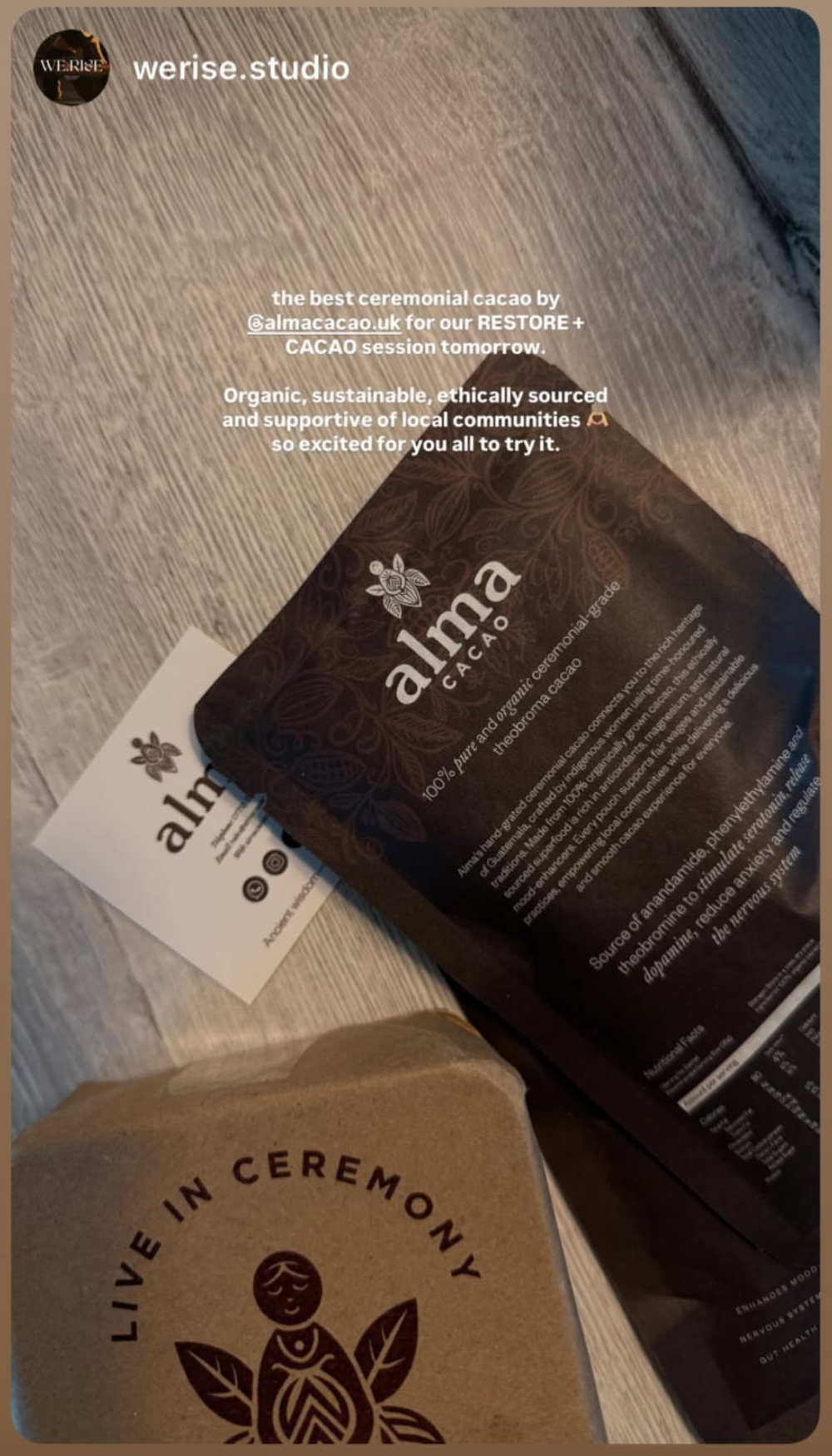
Alma Cacao is 100% pure ceremonial-grade cacao, handmade in Guatemala using traditional methods that preserve its full nutritional and energetic integrity.
Supermarket cocoa powders are typically highly processed, chemically treated, and stripped of cacao’s beneficial fats and compounds. Theyre often treated and heated at high temperatures during the production process which breaks down a lot of the magical compounds which make cacao such a special superfood in the first place!
Unlike these products, our cacao retains 100% of its natural oils, minerals, and mood-enhancing compounds—offering a deep, rich flavour and a powerful, nourishing experience. We don’t view cacao as just another ingredient — We understand that cacao is an ancient tradition, a daily ritual, a functional superfood, and the opportunity for us to connect to something deeper in the everyday.
Firstly, cacao is not a sweet drink (unless you add something), and that’s the beauty of it.
Ceremonial cacao has a rich, earthy depth unlike anything you’ll find in mass-produced cocoa or chocolate. Its taste is bold, complex and completely unique —think deep dark chocolate with subtle notes of fruit, spice, and smoke, depending on the region and roast. This is cacao in its purest form, full of character, with a creamy texture that comes from its natural cacao butter—never removed or diluted.
You can prepare Alma Cacao to suit your personal preference for taste. Drinking it with only water will be a lot more of a strong and bitter taste than blending it with 50% oat or coconut milk (our favourite!) which produces a delicious smooth and creamy taste.
Our founder Craig prefers the sharp bitter taste and drinks his morning cacao with only hot water whereas Amy prefers the smooth creamy taste of coconut milk and honey blended for her morning ritual - so there really is no ‘right or wrong way’ – there’s only your way.
At Alma Cacao, we don’t just mass produce cacao and call it ceremonial—we honour it.
Every bar is handcrafted using traditional, time-honoured methods that preserve the full integrity of the bean and the traditions where these methods come from. Unlike industrial production, which often separates and removes the natural oils and compounds, we keep everything intact: theobromine, anandamide, PEAs, and the rich natural cacao butter. These elements aren’t just good for you—they’re what give our cacao its signature velvety texture and deep, layered flavour.
Our cacao is made entirely by hand—harvested, peeled, and stone-ground by an indigenous women’s collective in Guatemala—ensuring every bar carries the care, skill and spirit of the people who make it. It’s cacao with a heartbeat.
Preparing cacao at home is simple and easy and can be varied to suit your own taste and preference. Here’s our go to recipe to get you started:
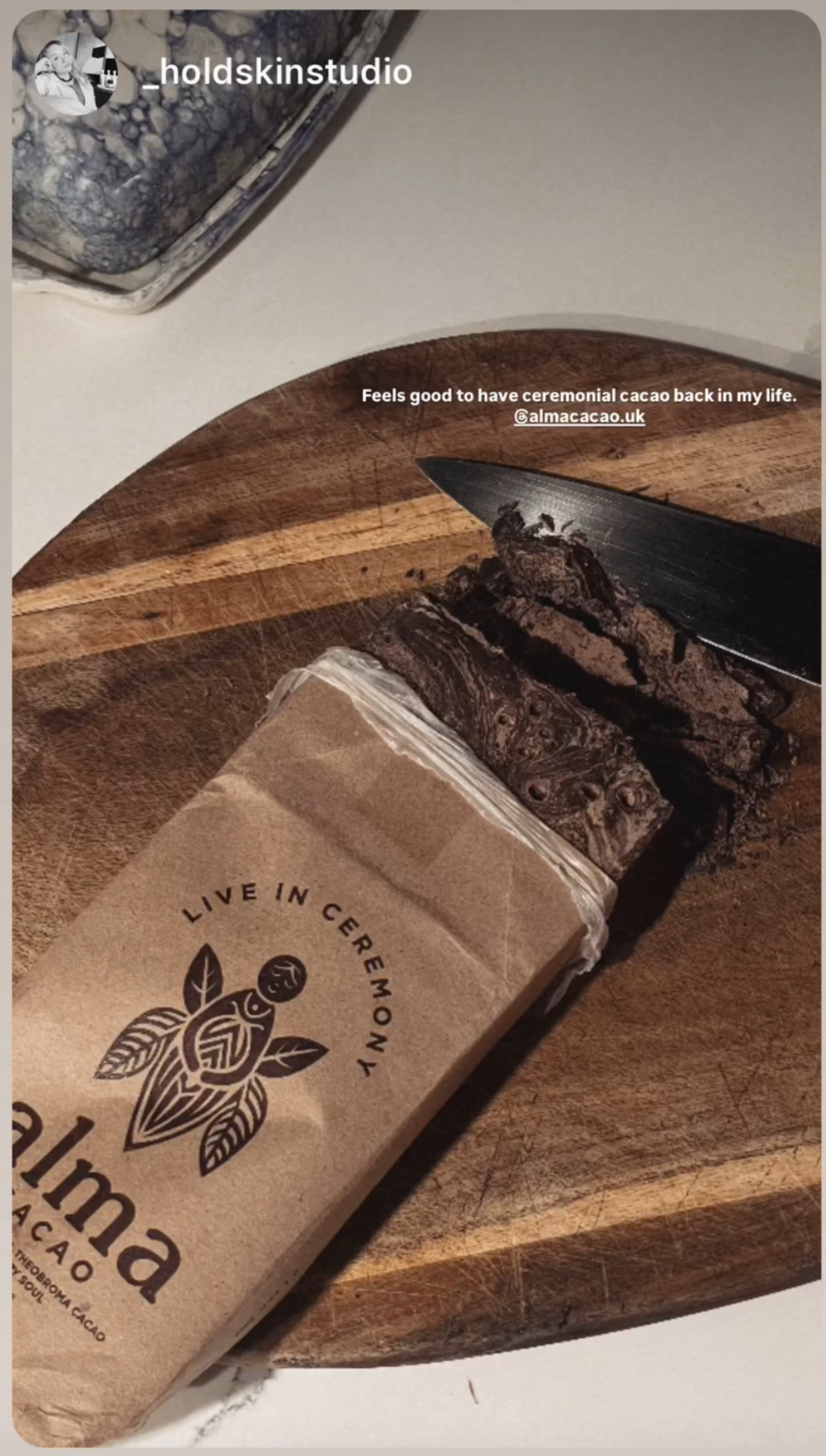
- Gently heat a cup’s worth of ½ water / ½ plant milk of your choice (coconut is our favourite!). *Don’t boil, this should be a gentle heat and the liquid should never boil–We’ve taken a lot of care to preserve the full spectrum of natural fats, oils and nourishing compounds which can be broken down if they get too hot.
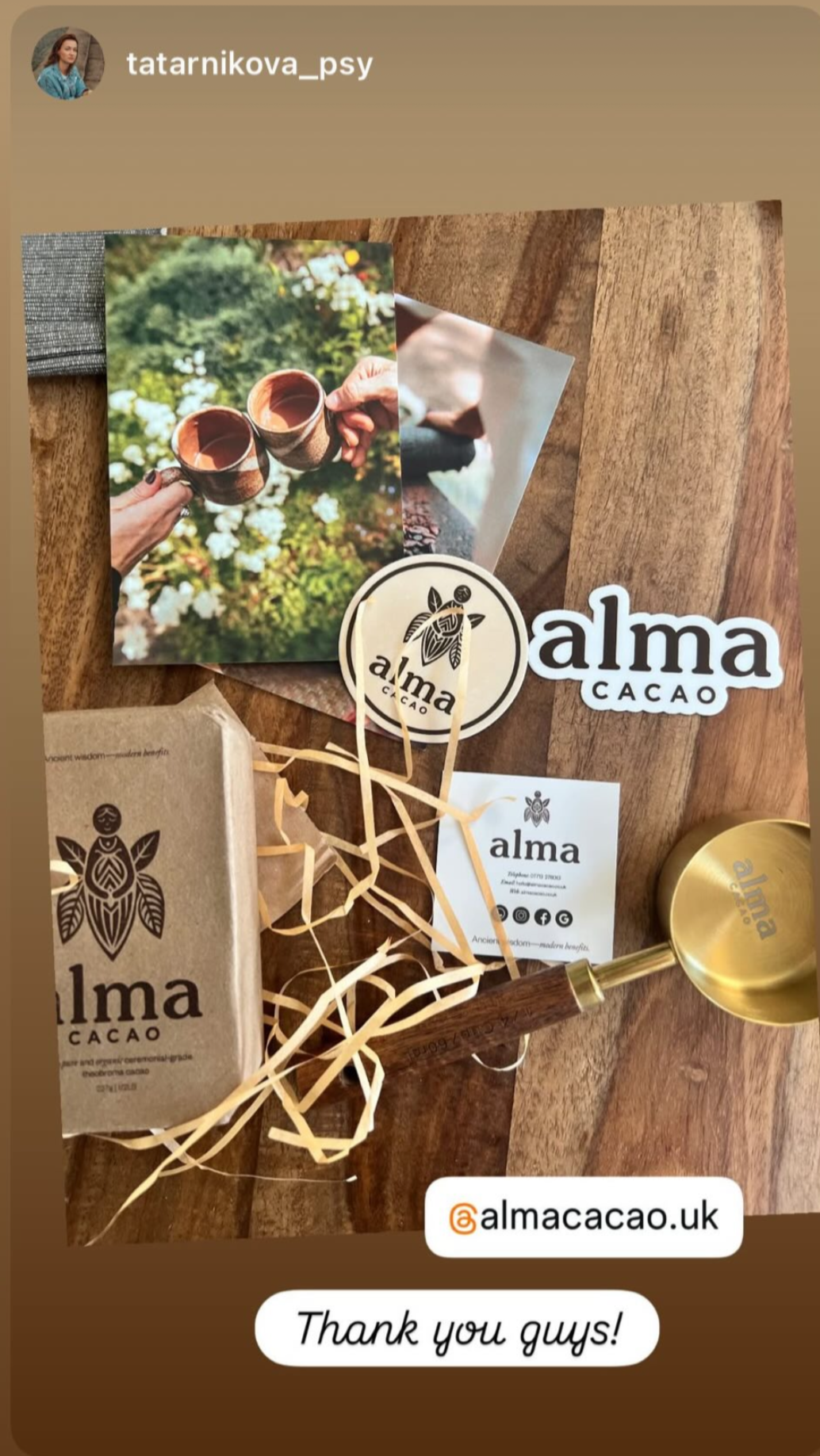
- Chop approx. 25g (or 1 scoop if you have our hand-grated cacao and custom alma scoop) and add this to the pan once the contents are nice and warm.
- Gently stir until the cacao is melted. Top tip: use a handheld milk frother here to give bring a creamy frothy texture to your cacao.
- Optional: Add honey, cinnamon, a dash of celtic sea salt or anything else you fancy to season to your taste.
- Enjoy and sip with intention.
Alma Cacao is designed for both. While it’s potent enough for ceremonial depth, it’s also gentle and nourishing for daily life. Whether you're journalling, working, creating, or simply grounding into your morning, our cacao meets you where you are—ritual optional, benefits always included.
In fact one of the core reasons why we created Alma was to help gently bring ceremonial-grade cacao out of the exclusive ceremony space where many people don’t feel comfortable. Its our intention that ceremonial-grade cacao has an important role to place in the everyday lives of everyday people.
There is no denying that Ceremonial-Grade Cacao holds the undisputed title of the Original Superfood with benefits for both body and mind. It’s packed with antioxidants, flavonoids and essential minerals (like magnesium and iron) that support heart and brain health and overall wellness.
It's the powerful combination of a trio of very special compounds which naturally occur in very high quantities only found in cacao. It is the potent combined relationship between Theobromine, Anandamide and Phenylethylamine working together to create a deeply nourishing mind-body experience which lies at the heart of Cacao’s unique effects as a superfood for the mind, body, heart and (spirit!).
Unlike coffee, cacao provides a gentle energy boost through theobromine, a mild stimulant that enhances focus and mood without the jitters or crash of caffeine. It also contains mood-elevating compounds such as anandamide and PEA (phenylethylamine). These are often called the “bliss” and “love” chemicals, known for promoting positive feelings, clarity, and stress relief. Many people find that enjoying pure cacao helps them feel more centered, uplifted, and connected.
We’re serious about the science-backed health benefits of ceremonial cacao and if you’re a cacao-science nerd like us then you can check our health benefits page for a deeper dive into the health science of this soulful superfood.
Alma Cacao contains no added caffeine, but it does contain a naturally occurring compound called theobromine – a gentle stimulant found in cacao that offers a sustained energy boost without the spikes and crashes of coffee.
Theobromine primarily stimulates the cardiovascular system (rather than the central nervous system like caffeine), making it less likely to cause jitteriness, anxiety or sleep disturbances. Many people find that cacao actually calms the nervous system while increasing focus and alertness. That said, everyone is different – if you're especially sensitive to stimulants, we recommend enjoying your cacao earlier in the day to see what works best for your body.
Every experience is unique – but most people describe ceremonial cacao as heart-opening, grounding, and gently uplifting. Thanks to its natural compounds like anandamide, PEA, and theobromine, cacao can create a sense of calm focus, lightness in the heart, and deeper emotional connection.
Cacao is non-psychoactive and is not a hallucinogen. It can create feelings of bliss and joy and openness depending on the dosage used.
You might feel more present, more creative, or simply more you. That’s why so many people use it to support meditation, journaling, deep work, or even just a mindful ritual to start their day. The best way to understand how cacao feels? Try it and see what it brings up for you.
Here you can place an explanation or answer to the question.
Not at all. Cacao can be used however it best serves you. For some, it’s a tool for emotional healing and spiritual connection. For others, it’s a nourishing daily ritual that supports energy, focus, and mood.
You don’t need to subscribe to any particular belief system to enjoy cacao. What matters most is that you approach it with presence, care, and respect—for the plant, for yourself, and for the people who grew and made it.